How UK Property Buyers Are Building Solar Equity in Their Communities
Leverage your property investment to accelerate solar access for low-income communities while building portfolio value. Property Saviour and similar initiatives connect property equity with renewable energy projects that deliver measurable social impact alongside financial returns.
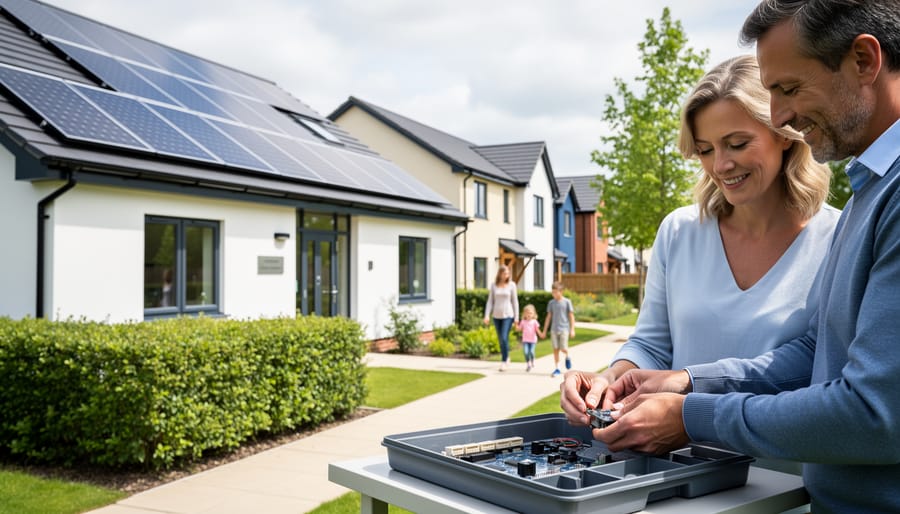
Transform unused equity in your UK property into community solar investments that reduce energy poverty. Instead of letting capital sit idle, property owners are redirecting £20,000 to £150,000 from remortgaging or equity release into solar equity programmes that install panels on social housing estates, schools in underserved areas, and community centres. These programmes typically offer 4-6% annual returns while slashing electricity bills for families struggling with fuel poverty.
Partner with established community energy cooperatives that structure solar equity investments as loan notes or shares. These proven models allow property buyers to commit funds for 10-20 year terms, receiving regular interest payments while their capital finances solar installations on properties owned by housing associations and local councils. The panels generate clean power for decades, cutting carbon emissions and energy costs for the very households most vulnerable to rising utility prices.
Right now, over 200 community energy groups across Britain need capital to expand solar access. Property owners sitting on £500 billion in untapped equity represent an enormous opportunity to close this funding gap. When you connect your property wealth to these programmes, you join a growing movement of investors who refuse to choose between financial security and climate action.
The mechanics are straightforward but the impact runs deep. Every pound redirected from property equity into community solar removes barriers that have kept clean energy out of reach for working families. This isn’t charity. It’s strategic investment that recognizes environmental justice and portfolio diversity as complementary goals, not competing priorities.
What Solar Equity Programs Mean for Property Buyers
Solar equity programs represent a fundamental shift from thinking about solar power as something you install on your own roof to viewing it as a shared community resource. Unlike traditional solar installations where property owners generate power solely for their own use, solar equity programs pool resources and distribute benefits across entire neighborhoods, particularly reaching households that have historically been locked out of the clean energy transition.
At their core, these programs address a simple injustice: the families most burdened by high energy costs are often the least able to access solar power. Renters can’t install panels on properties they don’t own. Low-income homeowners may lack the credit score or upfront capital traditional solar companies require. Social housing residents face systemic barriers even when their roofs are ideal for solar generation.
- Solar equity
- The principle that clean energy benefits and opportunities should be accessible to all community members, regardless of income, housing status, or property ownership.
- Community solar
- Shared solar installations where multiple participants collectively benefit from a single solar array, typically located on a community building, unused land, or social housing.
- Energy burden
- The percentage of household income spent on energy bills, which disproportionately affects low-income families who may spend 10% or more of their earnings on electricity and heating.
- Shared renewable energy
- Models that allow property buyers to invest in or support solar installations that serve multiple households, spreading both costs and benefits across a wider community.
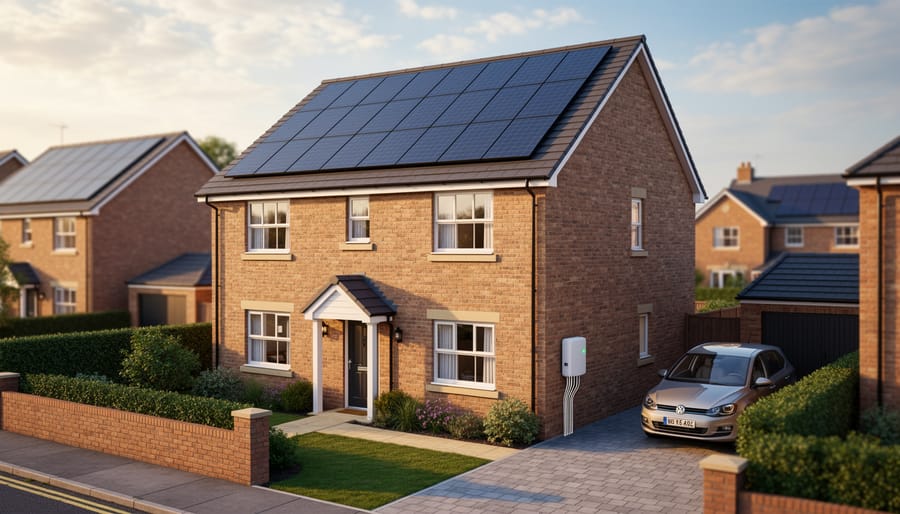
Property buyers enter this equation as potential catalysts. When you participate in a solar equity program, your investment or property becomes part of a larger system designed to lower energy costs for families struggling with fuel poverty while accelerating renewable energy deployment. You might invest in community shares that fund solar panels on a housing association block, or partner with a local cooperative to develop solar capacity that directly reduces energy bills for nearby low-income households.
The distinction matters because it transforms solar from an individual consumer decision into collective climate action with measurable social outcomes. You’re not just generating clean kilowatt-hours; you’re redistributing access to affordable energy and building community resilience against both climate change and economic hardship.
The UK’s Growing Solar Equity Movement
Community Energy Cooperatives Leading the Way
Across Britain, property buyers are joining forces through community energy cooperatives that prove renewable power can belong to everyone. In Brighton, the Brighton & Hove Energy Services Cooperative turned its members’ investments into rooftop solar arrays across local schools, delivering clean electricity directly to classrooms whilst paying dividends back to those who funded the panels. Similarly, Plymouth Energy Community has installed community-owned wind and solar across seventeen sites, transforming initial capital from homeowners into lasting energy assets that serve thousands.
These cooperatives work through a straightforward model: property buyers purchase shares, typically ranging from £50 to £10,000, which finance solar installations on community buildings, social housing estates, or commercial rooftops. The generated electricity either supplies the host building at reduced rates or feeds into the grid, creating revenue that returns to members whilst slashing carbon emissions. In Bristol, Mongoose Energy attracted over 150 local investors who collectively funded four solar farms, demonstrating how regional property wealth can mobilize significant renewable capacity.
What sets these initiatives apart is genuine local control. Members vote on project selection, review financial performance annually, and watch their investments power the places they live. A homeowner in Leeds invested £2,000 in their cooperative five years ago; she now receives steady returns whilst knowing her capital installed panels that cut fuel poverty for her neighbours.
Social Housing and Solar: Breaking Down Barriers
Social housing residents face disproportionate energy poverty, spending higher percentages of income on heating and electricity while living in less efficient homes. Solar installations on social housing estates offer a powerful solution, but upfront capital remains a persistent barrier for housing associations operating on tight budgets.
Innovative programs are now bridging this gap by connecting private property buyers with social housing solar projects. In Leeds, the Solar for Social Housing initiative enables local property investors to fund panel installations on council estates through a community investment fund. Residents benefit from reduced electricity bills, while investors receive steady returns indexed to energy savings. Over three years, the program has installed solar on 400 social housing units, cutting tenant energy costs by an average of £340 annually.
Brighton’s Community Energy Plus takes a different approach. Property buyers can purchase solar bonds specifically designated for installations on housing association properties serving low-income families. The bonds generate 4% annual returns while guaranteeing that 100% of the energy savings go directly to residents. This model has attracted over 200 local property owners, demonstrating how private capital can address energy injustice without extracting value from vulnerable communities.
These programs prove that social housing solar need not depend solely on public funding. When structured with community benefit at the centre, private property buyers become partners in expanding renewable access where it matters most.
How Property Buyers Can Participate in Solar Equity Programs
Investment Models That Work
UK property buyers have multiple accessible pathways to invest in solar equity programs, each designed to match different financial capacities and involvement preferences.
Community share offers represent the most direct form of participation. These schemes allow buyers to purchase shares in community-owned solar installations, typically starting from £50 to £500 per share. Returns usually range between 3% and 5% annually, with the added benefit of knowing your investment directly funds solar panels on local community buildings, schools, or social housing. Brighton Energy Co-operative and Energy4All demonstrate this model successfully, with property buyers forming a substantial portion of their investor base.
Solar bonds provide another route, offering fixed-term investments with predictable returns. These bonds fund specific solar projects and typically mature between three and seven years. They appeal to property buyers seeking straightforward investment terms without ongoing governance responsibilities. The Brighton & Hove Energy Services Co-op has issued bonds that raised over £3 million for local renewable projects.
Cooperative membership combines investment with active participation. Property buyers become part-owners in energy cooperatives, gaining voting rights on project decisions while contributing capital. Annual membership fees remain modest, often between £1 and £20, with additional share purchases funding solar installations. This model creates genuine community ownership rather than passive investment.
Each structure prioritizes accessibility, ensuring property buyers at various financial levels can contribute meaningfully to expanding solar access while receiving fair returns. The key difference lies in the balance between financial return and community engagement each buyer seeks.
Partnership Opportunities with Local Organizations
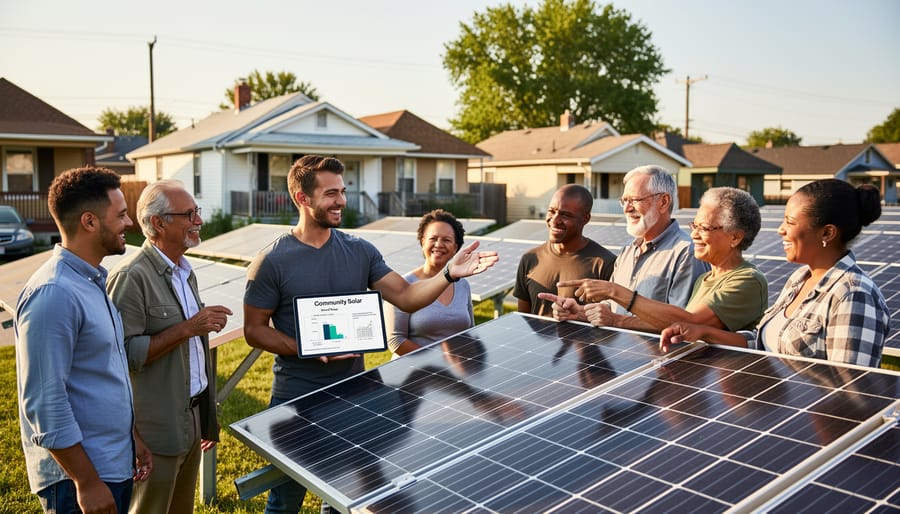
Property buyers looking to make a real difference don’t need to navigate solar equity alone. Across the UK, a growing network of organizations stands ready to facilitate meaningful partnerships that connect property ownership with community energy access.
Environmental justice groups like Friends of the Earth’s local networks offer established frameworks for property buyers to channel investment into neighborhoods facing energy poverty. These organizations have spent years building trust in underserved communities and understand precisely where solar infrastructure can deliver the greatest impact. They coordinate between willing investors and recipient communities, ensuring projects genuinely serve local needs rather than imposing solutions from outside.
Community development trusts present another powerful partnership avenue. These locally-rooted organizations manage assets for community benefit and often seek property buyer involvement in solar schemes that reduce energy costs for community facilities, youth centers, and elder care homes. The partnership model typically involves property buyers providing capital or securing their property as collateral while the trust handles project management and community engagement.
Local authorities increasingly welcome property buyer collaboration, particularly through council-backed community energy schemes. Many councils maintain registers of properties suitable for solar installation and can connect buyers with funding mechanisms like the UK Community Energy Fund. Some forward-thinking authorities have created dedicated solar equity liaison roles to smooth partnerships between private investors and social housing providers.
The key across all partnerships is reciprocity. Property buyers bring financial resources and stability; community organizations contribute local knowledge, established relationships, and project management expertise. Together, they create solar equity programs that neither could achieve alone.
Real Stories: Property Buyers Making a Difference
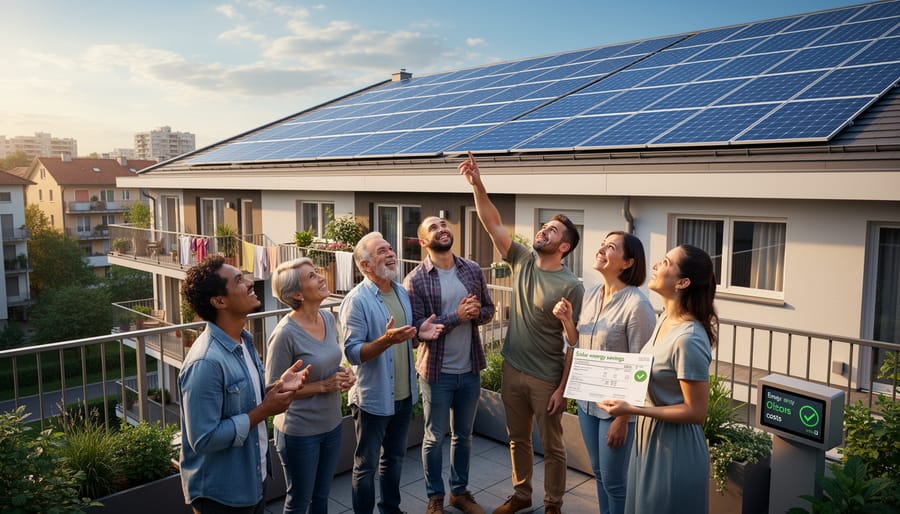
When Sarah Mitchell purchased her two-bedroom flat in Bristol in 2019, she never imagined her property investment would help power a community center in one of the city’s most underserved neighborhoods. Through Bath & West Community Energy, Sarah invested £2,000 in community solar shares alongside her mortgage payments. Three years later, the 250kW installation on a local youth center has cut energy bills by 60%, and Sarah receives a 4% annual return while watching the facility expand its after-school programs.
The impact extends beyond numbers. Sarah volunteers at the center quarterly, connecting with families who benefit directly from the reduced operating costs that freed up funding for educational programs. “I wanted my property wealth to mean something beyond personal gain,” she explains. “Seeing kids access programs that wouldn’t exist without affordable energy makes every pound feel purposeful.”
In Leeds, retired teacher James Okonkwo took a different path. After selling his family home and downsizing in 2021, James partnered with Leeds Community Homes to finance solar installations on three social housing blocks. His £15,000 investment through a cooperative bond scheme now provides renewable electricity to 47 households, cutting their energy costs by an average of £380 annually.
James meets quarterly with residents who share how the savings transformed their lives, one single mother afforded her daughter’s school uniform, another elderly couple could finally heat their home adequately through winter. The financial return matters less to James than the relationships formed. “Property gave me security. This gives me purpose,” he says.
Further north in Glasgow, first-time buyers Aisha and Tom Chen joined the Clyde Valley Community Energy cooperative immediately after purchasing their starter home. Contributing £500 initially and £50 monthly, they’re part-owners of solar arrays across community buildings in Possilpark, an area with significant fuel poverty. Their involvement sparked a neighborhood-wide conversation about energy justice.
The couple now hosts informational sessions for other young buyers, demystifying solar equity participation. “We thought solar programs were only for people with detached houses and big gardens,” Aisha shares. “Learning we could contribute meaningfully as flat owners changed everything about how we see our role in the community.”
These stories reveal a pattern: property buyers discovering that wealth can build bridges, that investment can foster belonging, and that individual action creates collective transformation. They’re not exceptional people, they’re ordinary property owners who recognized an opportunity to align their assets with their values.
Financial and Social Returns for Participating Property Buyers
Property buyers entering solar equity programs discover returns that extend far beyond conventional investments. The financial dimension presents genuine opportunities: community solar bonds typically yield 3-5% annual returns over 15-20 year periods, outperforming many traditional savings vehicles while supporting tangible infrastructure. Unlike volatile stock portfolios, these investments anchor to physical assets generating predictable income streams through feed-in tariffs and power purchase agreements.
Properties near community solar installations often see enhanced appeal among environmentally conscious buyers, though quantifying exact value increases remains challenging given the UK market’s complexity. More immediate financial benefits emerge through energy bill reductions when programs include local tariff arrangements, plus potential tax reliefs as community energy policies evolve. Some cooperative models allow members to earn returns through shared ownership structures that distribute surplus revenue annually.
- Stable 3-5% returns over 15-20 years with lower volatility than equity markets
- Tangible local impact you can visit and measure in your own community
- Portfolio diversification into ethical infrastructure with predictable income streams
- Enhanced reputation and network connections through community leadership
- Capital typically locked in for long periods with limited early withdrawal options
- Returns modest compared to higher-risk investment vehicles
- Requires active engagement and time commitment for meaningful participation
- Policy changes could affect feed-in tariff rates and overall returns
Yet the social returns often prove more compelling for participants. Contributing to an energy-saving holistic approach transforms abstract climate concern into measurable action, with each installation displacing thousands of tonnes of carbon annually. Property buyers report profound satisfaction watching vulnerable households gain energy security through their investment, directly witnessing reduced fuel poverty in their postcodes.
Community resilience strengthens as local energy generation reduces grid dependency and keeps energy spending circulating within regional economies rather than flowing to distant corporations. Participating property buyers gain standing as environmental leaders, opening doors to networks of change-makers, local government consultation opportunities, and meaningful civic engagement that enriches their connection to place. These intangible returns accumulate daily, creating legacy impact that transcends balance sheets while still delivering respectable financial performance.
Overcoming Barriers: What Needs to Change
Despite growing interest, UK property buyers face real challenges when trying to participate in solar equity programs. Understanding these barriers, and the emerging solutions, helps us chart a path forward.
Policy frameworks remain fragmented. The UK lacks comprehensive low-wealth solar policy that explicitly connects property ownership to community benefit schemes. Planning regulations often treat community solar differently across local authorities, creating confusion for potential participants. The Feed-in Tariff closure in 2019 removed a key financial incentive, though the Smart Export Guarantee offers some replacement. What we need: coordinated national guidance that recognizes property buyers as community energy stakeholders, with clear pathways for participation alongside standardized legal frameworks for solar equity investments.
Financing presents another hurdle. Traditional mortgage products don’t account for community solar investments, and many property buyers remain unaware that community shares or solar bonds exist as investment vehicles. Banks and building societies rarely promote these options during property transactions. Community energy groups themselves often struggle with capital requirements for larger projects. The gap shows: targeted financial products designed for property buyers wanting to support solar equity, plus mainstream lender education about community renewable investments as viable options.
Awareness stands as perhaps the biggest barrier. Most UK property buyers simply don’t know solar equity programs exist or how their property ownership could catalyze clean energy access for others. Estate agents and conveyancers rarely mention community energy opportunities. This information gap perpetuates itself, people can’t advocate for what they don’t know about.
Progress emerges through advocacy. Community energy organizations are pushing for improved renewable energy legislation that centers equity. Local councils in Bristol, Brighton, and Edinburgh have pioneered policies supporting community solar partnerships. Property buyer networks now share information about participation pathways, building momentum from the ground up. Each voice advocating for clearer policy, better financing, and broader awareness moves us closer to systemic change.
Taking Action: Your Next Steps Toward Solar Equity
Your journey toward solar equity starts with a single conversation. Here’s how to move from interest to impact in your community.
- Research local community energy organizations in your area. Contact groups like Community Energy England or your regional energy cooperative to learn about existing solar equity projects seeking property buyer involvement.
- Attend a community energy meeting or webinar. These gatherings connect you with experienced participants, clarify investment models, and reveal immediate opportunities in your region.
- Calculate your potential contribution. Determine how much capital you can direct toward solar equity, whether through community shares starting at £100 or larger cooperative investments.
- Connect with your local council’s renewable energy team. Many authorities actively seek private sector partners for social housing solar projects and can outline specific partnership pathways.
- Join a solar equity advocacy network. Organizations working toward recognition through initiatives like the solar justice award often welcome new members who bring property ownership perspectives and resources.
- Commit to a pilot project. Start with one meaningful investment or partnership, learn from the experience, and expand your involvement as you witness the community transformation firsthand.
The organizations you connect with today become your partners in building energy justice tomorrow. Document your journey, share learnings with fellow property buyers, and advocate for policy changes that make solar equity participation easier for those who follow. Your property ownership represents more than personal wealth; it’s potential energy for community empowerment. The solar equity movement needs your capital, your influence, and your commitment to ensure clean energy reaches everyone, not just those who can install panels on their own roofs.
The future of clean energy in the UK doesn’t rest solely with governments or corporations, it lives in the choices ordinary property buyers make today. When you invest in solar equity programs, you’re not just adding renewable capacity to the grid. You’re dismantling the barriers that have kept clean energy as a privilege rather than a right.
Every property buyer who joins a community energy cooperative, funds social housing solar installations, or advocates for public participation in clean energy policy becomes a catalyst for systemic change. These individual actions accumulate into something far greater: communities where energy costs don’t force impossible choices, where local ownership builds resilience, and where the benefits of the renewable transition reach those who need them most.
The path forward is clear and within reach. Across the UK, property buyers are proving that homeownership can be a tool for justice rather than inequality. They’re showing that financial returns and social impact aren’t opposing forces, they strengthen each other.
The solar equity movement needs your voice, your investment, and your vision. The communities around you need partners in building a cleaner, fairer energy future. Start small if you must, but start today. The equitable, community-owned renewable energy landscape we need won’t build itself, it requires property buyers willing to see their investments as bridges to collective prosperity.